What this job involves and what it costs
Electric gate wiring installs a dedicated, armoured supply, controls and safety devices for automated gates, with fixed written pricing based on distance, trenching and equipment. Serving Medway and surrounding areas including nearby villages and suburbs. Work is fully certified and guaranteed: new circuit with RCD protection, weatherproof isolator, tested earth continuity and safety device certification supplied on completion.
When you need it
- My gate trips the house breaker, loses power suddenly, or works on and off.
-
This usually means the gate wiring or supply is faulty or overloaded and needs inspection.
-
The gate won’t accept keypad codes, fobs stop working, or the video intercom keeps cutting out.
-
This usually means the control wiring or power supply for the access equipment is incorrect or unreliable.
-
I’m worried the gate might hit a car, a person, or my pet because sensors don’t seem to catch them.
-
This usually means safety sensors are missing, poorly positioned, or not properly tested.
-
There are exposed or damaged cables at the gate, damp around the connections, or the wiring looks very old.
-
This usually means the outdoor electrical connections aren’t watertight or up to current standards and need replacing.
-
I’ve had new pillars or a moved driveway and now the gate controls are in the wrong place or won’t reach.
-
This usually means the control wiring needs extending or rerouting to match the new layout.
-
The gate behaves oddly after a new automated unit is fitted, or after someone else connected it.
- This usually means the circuit wasn’t assessed or wired correctly when the equipment was installed.
All fixes include testing and earthing checks so the gate works reliably and safely.
What it costs in Medway
For electric gate wiring in Medway we provide a fixed written price before work starts so the bill won’t exceed the quote. Gate automation wiring is quoted per job after a free survey because cable route, supply capacity, controls and safety devices vary.
| Job | Price | What's included |
|---|---|---|
| Electrical labour | £80 per hour | Labour for wiring, testing, certification and VAT |
| Day rate | £600 | Full day labour, testing, certification and VAT |
| Emergency attendance | £120 per hour (first hour minimum) | Emergency call-out labour, testing, certification and VAT |
Not included: trenching (assessed separately), plastering, decoration, asbestos removal, DNO supply-upgrade charges, scaffold/access equipment or any unspecified alterations to consumer units or dedicated circuits (these will be specified in the written quote).
What is involved on the day
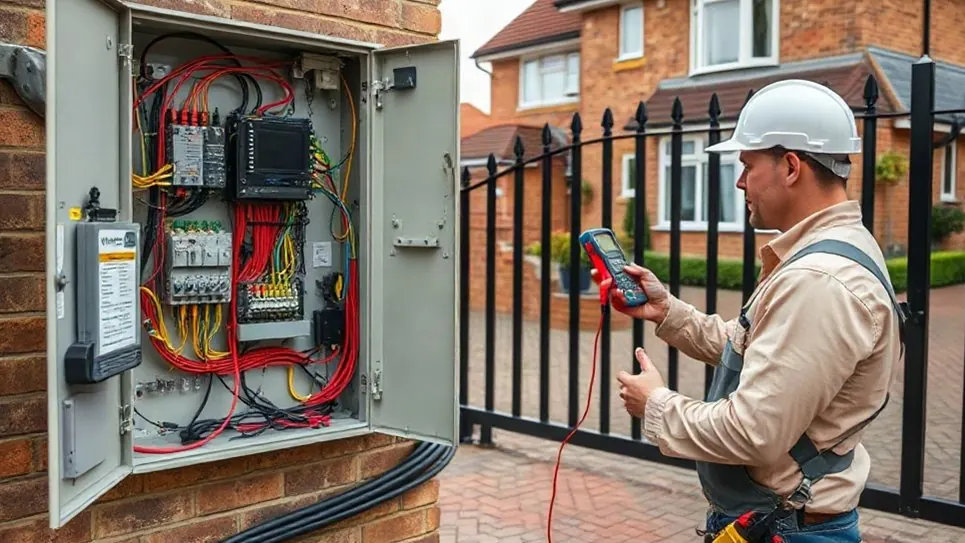
We survey the gate area, confirm the agreed cable route and safely isolate the relevant supply before work starts. We install the wiring and protective equipment, then test operation, earthing and safety controls. Once compliant, we issue the appropriate electrical certificate for your records.
Survey and isolation
Before any electric gate wiring begins, we survey the gate motors, control equipment, cable route and existing supply to confirm the installation is safe and suitable. We check for damage, unsuitable cable types, water ingress, exposed conductors and signs that the existing circuit may be overloaded. Where the property has older wiring, we assess its condition before relying on it for the gate supply.
We complete a risk assessment covering vehicle movement, gate operation, underground services, access routes and the location of the consumer unit. We identify the correct circuit, notify anyone affected and apply isolation procedures before testing or handling conductors. The supply is proved dead with suitable test equipment, then secured to prevent accidental reconnection. This lets us work safely while protecting you, visitors, pets and the property.
Installation
Once isolation is confirmed, we install the dedicated gate supply, containment and control wiring in line with the agreed route. We use suitable cable types for buried, external or internal sections, protecting them in appropriate conduit, trunking or ducting where required. At the consumer unit, we fit the specified protective devices and label the new circuit clearly.
We position junctions and isolators where they remain accessible, keep low-voltage controls separate from mains wiring, and seal external entries against moisture. Where the route crosses driveways or planting areas, we install mechanical protection at the agreed depth. Our work follows current safety standards, minimising disturbance to finished surfaces and existing services. We also connect the gate operator, photocells, keypads and intercom cabling as specified, leaving wiring neat, secure and ready for commissioning.
Testing
After installation, we test the gate circuit, protective devices and earthing arrangements to confirm they operate safely. Our safety testing includes continuity checks on protective conductors, insulation-resistance testing and polarity verification, so we can identify damaged cable, walderslade connections or incorrect terminations.
We test the circuit’s disconnection arrangements and confirm the RCD protection operates within the required limits. Where the gate system has photocells, safety edges, stop controls or emergency release functions, we check that each device responds correctly and prevents unsafe movement.
We also run the gate through opening and closing cycles, observing cable protection, control equipment and access points. If we find a fault or an unsafe condition, we explain it clearly and rectify it where agreed before leaving. This guarantees your new wiring is ready for reliable, safe operation.
Certificate
When the gate wiring has passed testing, we’ll issue the appropriate electrical certificate for the work completed, detailing the circuit, test results and any protective measures installed. This safety certificate confirms that the new or altered wiring has been inspected, tested and recorded in line with the relevant electrical requirements.
We’ll give you clear compliance documentation for your records, including the circuit reference, cable type, protective device rating, earthing arrangements and RCD test results where applicable. Keep it with your gate manuals and property paperwork, as it may be useful for maintenance, fault finding, insurance or future alterations.
If the installation requires notification under Part P, we’ll make sure the required process is completed. Your certificate applies to the electrical work we’ve carried out, not unrelated existing wiring or gate mechanics.
Options and what we recommend
For most Medway homes, we recommend a dedicated, RCD-protected supply from the consumer unit for the gate system, with a local isolator and correctly rated underground cable in ducting. This gives dependable protection, easier isolation and capacity for the motors, controls and safety devices.
| Option | Our recommendation |
|---|---|
| Supply route | Armoured cable in buried ducting |
| Controls | Hard-wired safety devices; Wireless control for access |
| Existing wiring | Inspect before connection |
| Metalwork | Check bonding and Aluminium corrosion risks |
We’ll select cable size after evaluating route length, load and voltage drop. Where a gate is remote from the house, trenching and ducting are usually the sturdy choice. Wireless control is convenient, but we don’t rely on it for essential safety circuits. If existing post-war wiring is present, we’ll evaluate its condition rather than extend it.
Rules and certificates
The cable route and supply arrangement influence which electrical paperwork we can provide. A new circuit for electric gates is generally notifiable under Part P of the Building Regulations in many circumstances; where notification is required, Part P–registered electricians (such as NICEIC-registered contractors) may be able to self-certify and notify Building Control and issue an Electrical Installation Certificate (EIC) for the new work. Replacing a consumer unit or carrying out work in a “special location” can also be notifiable, depending on the specifics of the installation.
If we add equipment to a suitable existing circuit and the work falls within the scope of minor works, we can issue a Minor Electrical Installation Works Certificate where appropriate. Before handover we test earthing, protective devices, cable protection and operation. An Electrical Installation Condition Report (EICR) is not a certificate for new work; it reports on the condition of an existing installation and any observed safety issues.
Planning permission may be required for gate structures or for work affecting listed buildings; this is separate from electrical compliance. Keep any certificates safely, as they can be relevant to insurance and future property records.
Older homes around Medway
In Medway we frequently encounter older housing that can need extra investigation before we wire electric gates. In the town centre and in Brompton, many homes are Victorian terraces built in the late 19th century, and in parts of Walderslade and Blue Bell Hill we also see substantial inter-war semi-detached houses from the 1920s and 1930s.
When we visit a Victorian terrace in Brompton or a town-centre property in Medway we will inspect the consumer unit, earthing arrangements and likely cable routes before confirming how we will install the gates. We will not connect gate equipment to an unsuitable circuit in a Blue Bell Hill semi or a Walderslade period house simply to keep costs down.
If our testing in a Medway property identifies deteriorated insulation, missing earth continuity or an inadequate supply, we will explain the corrective work needed for that specific house and provide a fixed written price before proceeding.
How long it takes and whether you lose power
Most electric gate wiring in Medway can be completed within a day, although the exact duration depends on the cable route, distance from the consumer unit and whether the existing supply is suitable. We’ll assess access, excavation requirements, isolation points and the gate equipment before confirming the work sequence.
A short, planned power outage may be needed when we install protective devices or connect the new circuit at the consumer unit. We’ll keep isolation limited to the necessary period and carry out downtime planning around your household or business needs. If essential equipment must remain live, we can discuss a temporary supply or a backup generator before work begins. We test the circuit, earthing and safety devices before energising the gates, so the installation is safe, reliable and properly certified.