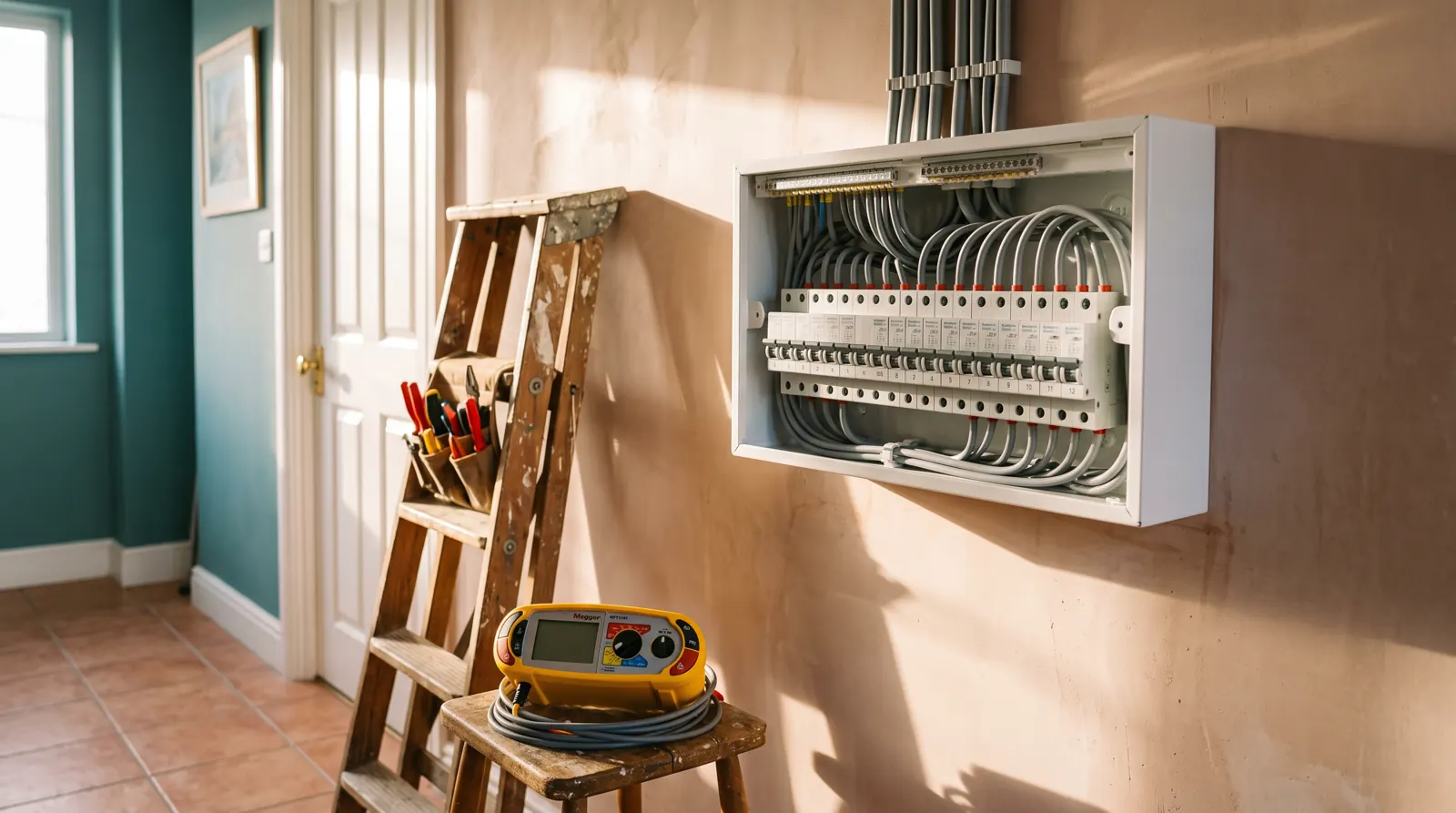

What we do and who it is for
Structured cabling and fibre installation from £XXX, providing organised wired infrastructure for data, voice, Wi‑Fi, cameras and networked equipment. All work is tested to industry cable standards, fully certified and backed by a workmanship guarantee.
The property mix in Medway — dense Victorian terraces in Strood, Chatham and Gillingham, dockyard-era housing, large post-war estates and new-build on the riverside and at Rochester Riverside — means no two jobs are alike. Our electricians spend much of their time on dense rental and HMO stock across five towns, landlord EICRs and fire alarms, riverside new-build snagging and EV chargers, and we plan each visit around the age of the wiring rather than a one-size-fits-all checklist.
Typical jobs
We install structured cabling across Canterbury and its surrounding neighbourhoods, tailoring each job to local street layouts and housing types.
- Home‑office data points in Victorian mid‑terraces in the Cathedral Quarter and Edwardian semis in St Dunstans are installed and linked back to the customer’s router or our small on‑site cupboard.
- Segregated links for CCTV, door entry and alarm communicators installed for owners of 1930s semis in St Dunstans, for estate managers of modern apartment blocks in Canterbury East, and for AV systems in listed homes near the Cathedral.
Whenever we work in Canterbury we assess the exact cable routes through the town’s narrow alleyways and older loft spaces, check containment options in solid‑walled Victorian properties, and determine whether external‑grade cable is needed for garden runs in Wincheap or along riverfront properties by the Stour. Where fibre is the right choice for crossings between buildings in the University area or long garden runs in Sturry, we plan protected routes and install suitable termination enclosures matched to the local property type.
What it costs
Structured cabling and fibre work are quoted per job after a free survey, with cable types, route, containment and termination hardware confirmed before we provide a fixed written price. Below are typical job options and what each quoted price covers.
| Job | Price | What's included |
|---|---|---|
| Fibre link | Quoted per job after a free survey | Parts, labour, testing, certification, VAT |
| Structured cabling | Quoted per job after a free survey | Terminations, labelling and Remote testing |
| Fault diagnosis | £80/hour | Labour; most faults traced in 1–2 hours |
Not included: plaster making-good, decoration, asbestos removal and access equipment where needed.
How the work is planned
Before we install any fibre or data cabling, we survey the property, identify the required endpoints and confirm the route, containment, cable category and termination locations. Our site survey checks access routes, ceiling voids, risers, floor construction, existing containment and separation from power cabling. We’ll establish whether Cat6, Cat6A or fibre is appropriate for the required bandwidth, distance and equipment connections.
We then produce a practical installation sequence: first-fix containment where needed, cable pulls, labelling, termination and final testing. Resource scheduling accounts for access restrictions, occupied areas, delivery lead times and any work that must occur outside business hours. For Medway period properties, we plan routes carefully to reduce disruption to original plasterwork, joinery and visible finishes. We’ll also agree endpoint positions with you before cables are installed, so desk layouts, wireless access points and network equipment are correctly served.
Compliance and documentation
Once the installation route and endpoints are agreed, we document the cabling design, test results and handover information. Our records identify cable categories, containment routes, cabinet and patch-panel positions, receptacle numbering, labelling schedules and certification results. We provide documentation templates where a client needs consistent asset records across several Medway sites.
For any associated electrical supply work, we record inspection and testing appropriate to the installation. It is sometimes stated that fixed-wire testing is legally required at set intervals (for example five years for offices, three years for industrial premises and annually in other cases); that is not correct — the Electricity at Work Regulations 1989 require that electrical systems are maintained so as to prevent danger, but they do not prescribe fixed statutory retest intervals. Recommended intervals in industry guidance (for example IET Guidance Note 3) are commonly followed, and insurers, landlords or licensing bodies may require a current EICR, so we can align inspection and testing schedules with those expectations, the site risk assessment and the client’s maintenance arrangements.
Minimal disruption and out-of-hours working
To minimise disruption, we plan fibre and data-cabling work around your operating hours, access constraints and critical services. Before mobilisation, we agree work zones, cable routes, isolation requirements and a sequence that keeps essential network equipment available. We can schedule containment, drilling, cable pulling, termination and testing out of hours where this best protects your staff and customers.
For a quiet installation, we use agreed access routes, protect finished surfaces, control dust at drilling points and keep work areas contained. Noisy activities are grouped into defined windows, while low-impact tasks such as labelling, patching and certification can follow separately. We coordinate switchovers with your IT provider, retain rollback arrangements where practical, and test links before handover. Our out of hours rate is £120 per hour, quoted clearly in writing before work begins.
Premises and sites around Medway
Each Medway design identifies the exact cable categories and multimode or single‑mode fibre required for the ME2 and adjacent postcode sectors, the precise termination points, labelling and on‑site test requirements we will carry out before installation begins.
The property mix in Medway — dense Victorian terraces in Strood, Chatham and Gillingham, dockyard-era housing, large post-war estates and new-build on the riverside and at Rochester Riverside — means no two jobs are alike. Our electricians spend much of their time on dense rental and HMO stock across five towns, landlord EICRs and fire alarms, riverside new-build snagging and EV chargers, and we plan each visit around the age of the wiring rather than a one-size-fits-all checklist.