
What this job involves and what it costs
EICRs and electrical safety inspections for a typical three‑bedroom property from £150–£250 (VAT, labour and report included). Serving Medway and surrounding areas, we specialise in post‑war aluminium wiring and Victorian VIR/rubber cabling. All work is inspected, tested and recorded to current regulations and issued with the appropriate certificate; repairs quoted separately at a fixed written price and completed to certified safety standards.
When you need it
- You need paperwork after major electrical work is finished (for example, when we replace your fuse box or add a new circuit).
-
Usually means the work must be certified to prove it was done safely and to meet building regs.
-
Your home has been rewired or a new consumer unit fitted and you were handed a certificate.
-
Usually means the electrician has confirmed the fixed wiring meets safety standards.
-
You’re a landlord and your tenant asks for the electrical report or you’re told to provide it.
-
Usually means you must hold a satisfactory EICR (electrical inspection) and give tenants a copy.
-
Your tenant points out exposed wires, sockets that spark, or anything that looks unsafe.
-
Usually means there may be reportable defects that need fixing quickly to keep the property safe.
-
Your lights dim or blink when you switch the kettle, oven, or another appliance on.
-
Usually means a heavy load is tripping voltage or indicating a circuit is overloaded or poorly connected.
-
Sockets or switches keep tripping the breaker or RCD even when nothing obvious is plugged in.
-
Usually means a fault is present that needs an inspection to prevent shocks or fire.
-
You’ve had floodwater or impact damage to part of the house and notice persistent electrical problems afterward.
-
Usually means water or physical damage can compromise wiring and an inspection is recommended.
-
You notice scorch marks, burning smells, or sockets that feel warm to the touch.
-
Usually means an unsafe connection or overloaded circuit that needs urgent attention.
-
You’re planning major refurbishment and want peace of mind about the existing wiring.
-
Usually means an inspection will identify any issues before work starts and avoid surprises.
-
You need emergency access because there’s an immediate electrical danger (sparks, smoke, or loss of power to essential safety devices).
-
Usually means you should arrange urgent help and avoid touching damaged equipment.
-
You’re selling your Medway home and wondering if you need an EICR.
-
Usually means an EICR isn’t mandatory for sale, but having safe, documented installations reassures buyers and shows defects were checked.
-
You’re considering PAT testing for appliances and wondering if it’s legally required.
- Usually means portable appliance testing isn’t legally required for homeowners, though it can help demonstrate that appliances are safe.
What it costs in Medway
Typical costs for electrical work in Medway depend on property size, existing wiring condition and required testing; we provide fixed prices that include VAT, parts, labour, testing and certification. Below are our standard charges for common jobs.
| Job | Price | What's included |
|---|---|---|
| EICR, up to three-bedroom home | £150–£250 | VAT, parts, labour, testing and certification |
| EICR, four-to-five-bedroom home | £250–£350 | VAT, parts, labour, testing and certification |
| Commercial EICR | £30–£50 per circuit | VAT, parts, labour, testing and certification |
| Consumer unit replacement | £500–£700 | VAT, parts, labour, testing and certification |
| Three-bedroom rewire | £4,500–£8,000 | VAT, parts, labour, testing and certification |
| Fault attendance (non-emergency) | £80 per hour | Labour for fault diagnosis (first-hour minimum applies) |
| Emergency attendance | £120 per hour | Emergency labour (first-hour minimum applies) |
Not included: plaster repairs, decoration, asbestos removal, DNO supply-upgrade charges and scaffolding.
What is involved on the day
On the day, we’ll survey the work, explain any necessary isolation and make the area safe before installation begins. We’ll complete the agreed work, then test it to confirm it meets the relevant electrical safety requirements. Once the checks are complete, we’ll issue the appropriate certificate for your records.
Survey and isolation
Before we issue an electrical certificate, we’ll survey the installation, confirm what work is required and agree a fixed written price. We’ll identify the consumer unit, circuits, accessible accessories and any signs of damage, ageing cable or unsuitable alterations. Our survey documentation records the property details, scope, limitations and observations, so you understand what can be inspected safely.
Where testing requires supplies to be made dead, we’ll explain the likely interruption first. We follow safe isolation procedures: identify the correct circuit, isolate it, secure the point of isolation and verify it is dead using appropriate test equipment. You should tell us about essential equipment, alarms, medical devices, tenants or business operations before the visit. If a circuit cannot be safely isolated or accessed, we’ll record the limitation clearly and discuss the appropriate next step.
Installation
Once the survey and any necessary isolation are complete, we’ll carry out the agreed electrical work safely and in line with current requirements. We’ll protect floors and furnishings, confirm cable routes, and keep you informed before opening walls, ceilings or floorboards.
Where changes are planned, we’ll check socket placement is practical, accessible and suitable for the room’s intended use. We’ll also install lighting design elements as agreed, considering switching positions, bathroom zones, fire protection and suitable fittings. In older Medway properties, we’ll take particular care around existing VIR, rubber or aluminium wiring and may adapt the method if concealed conditions differ from the survey.
We’ll fit approved materials, make secure connections, label new circuits where applicable, and maintain safe working areas throughout. Any agreed variation will be explained clearly before we proceed.
Testing
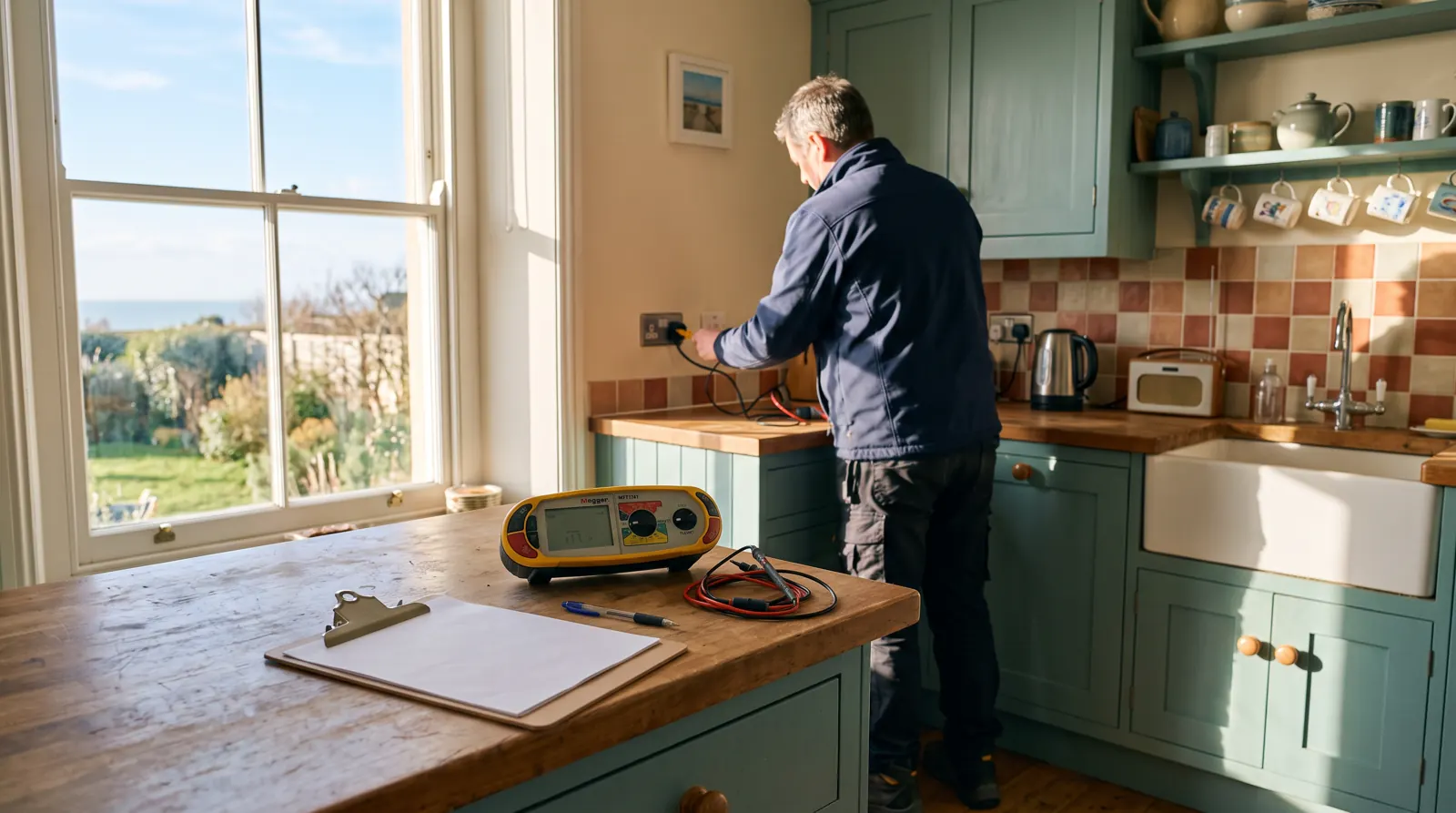
After the installation work is complete, we’ll test the circuits and equipment affected to confirm they’re safe and operating as intended. We’ll isolate supplies where necessary, carry out dead tests, then restore power for live checks under controlled conditions. This includes continuity, insulation resistance, polarity, earthing and RCD operation, in line with the relevant BS 7671 requirements.
Where appropriate, we’ll carry out socket load testing to check that connections remain secure and voltage performance is satisfactory under demand. We may also use thermal imaging to identify unusual heat at terminals, protective devices or connections that isn’t visible during a visual inspection.
You’ll be asked to keep clear of work areas while testing takes place. If we find a safety concern, we’ll explain it promptly, make the area safe where needed, and discuss the appropriate remedial work.
Certificate
Certification is the final record of the work completed. Once we’ve finished testing and any required corrections, we complete the appropriate document: an Electrical Installation Certificate for new work, a Minor Electrical Installation Works Certificate for smaller alterations, or an EICR for an inspection.
We’ll explain what the certificate covers, note any limitations, and give you the results, observations and next steps in plain English. You should check your name, address and installation details before accepting it. Our qualified electrician applies a digital signature, confirming responsibility for the inspection, testing and certification.
Please keep the document with your property records. It provides a useful certificate history for future electrical work, landlord compliance, insurance queries and alterations to the consumer unit. We can supply a copy if you need one later.
Options and what we recommend
The right certificate depends on the work and the property: we recommend an EICR to assess an existing installation’s condition, an Electrical Installation Certificate for new circuits or a consumer unit replacement, and a Minor Electrical Installation Works Certificate for smaller alterations such as an added socket.
| Situation | Best option | Our recommendation |
|---|---|---|
| Older wiring | EICR | Check condition first |
| New circuit | Electrical Installation Certificate | Test and document work |
| Added socket | Minor Works Certificate | Confirm safe alteration |
| Portable chargers | EICR if concerns arise | Avoid damaged leads |
| Seasonal maintenance | EICR or visual checks | Address deterioration early |
We’ll assess the installation before advising, particularly in older Medway homes where ageing cable or previous alterations may need attention. We don’t recommend unnecessary testing, but we won’t overlook defects that could affect safety.
Rules and certificates
For electrical work in England, whether a certificate is needed depends on the work carried out and whether the work is notifiable under Part P of the Building Regulations. Certain types of work — such as new circuits, consumer unit replacements and some work in bathrooms or other special locations — are commonly notifiable, but not every instance of those works will necessarily be notifiable; notification depends on the specific circumstances and the applicable regulations. As an NICEIC-approved, Part P-registered electrician we are able to self-certify qualifying notifiable work and notify Building Control where appropriate, but we will only do so where the work meets the criteria for self-certification.
We issue an Electrical Installation Certificate (EIC) for new circuits and consumer unit installations, and a Minor Electrical Installation Works Certificate for additions or alterations to an existing circuit. An Electrical Installation Condition Report (EICR) is different: it records the condition of an installation following inspection and testing, and is not itself an installation certificate.
Keeping appropriate documentation supports evidence of compliance and that work has been tested; which documents are appropriate will depend on the nature of the work. The period of validity or the recommended interval for re-inspection is not a fixed legal “expiry” for all certificates but depends on the certificate type, the condition of the installation and any inspection intervals recommended by the assessor or by guidance.
Older homes around Medway
In Medway we frequently find that Victorian terraces in the town centre and in Brompton (typically built 1850s–1900s) still contain vulcanised India rubber (VIR) or other early rubber-insulated cable, so we carry out careful assessments for those specific streets and properties.
We explain our observations in relation to the specific Medway street or estate, classify defects in line with EICR guidance, and issue the appropriate certificate after any qualifying electrical work carried out on properties in Medway and its named neighbourhoods.
How long it takes and whether you lose power
Most EICRs in a typical three-bedroom Medway home take around three to four hours, although larger properties, older wiring or limited access can extend the visit. We’ll provide realistic duration estimates before attending and ask that sockets, the consumer unit and key areas are accessible.
Some testing requires circuits to be isolated briefly, so you should expect limited power disruption during the inspection. This allows us to carry out dead testing and verify that protective devices operate correctly. We’ll minimise interruptions where possible, explain when supplies need switching off, and take extra care where refrigerated food, medical equipment, alarms or home-working equipment are involved.
You don’t need to leave the property, but someone should normally be available to provide access and discuss any safety observations we identify.