What an EICR is and who needs one
An EICR is a formal inspection of a property’s fixed electrical installation that we recommend at least every five years for social housing and which typically costs from £150–£300 per dwelling.
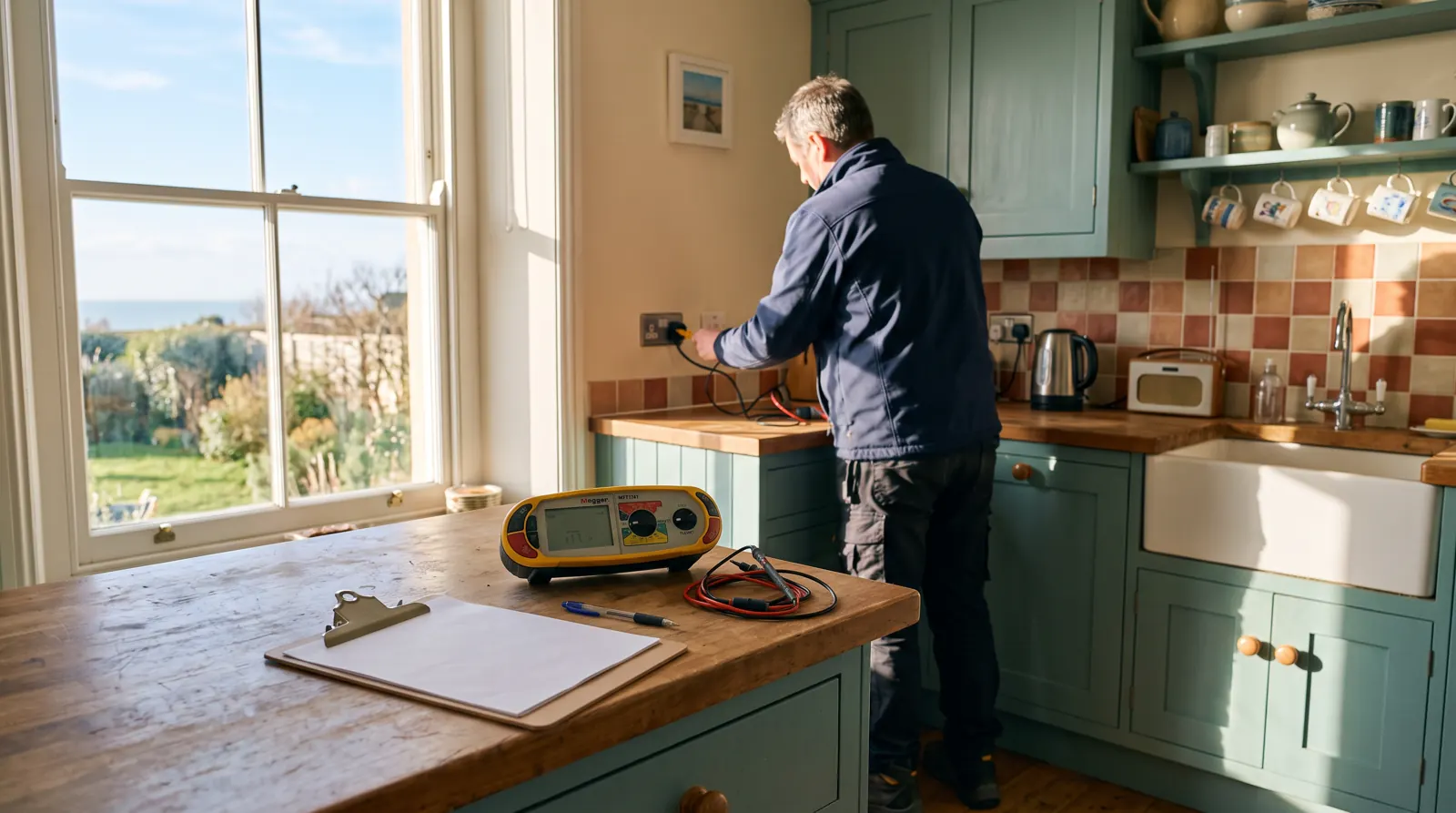
An Electrical Installation Condition Report (EICR) assesses the consumer unit, wiring, sockets, switches and protective devices to determine whether the installation is safe for continued use, identify defects and record observations using recognised classification codes. For social housing, landlords must guarantee tenant safety and arrange EICRs at least every five years, or sooner where a previous report requires remedial work. We recommend prompt checks following flood damage, alterations, changes of occupancy or concerns about historical wiring — this is particularly relevant in Medway’s Victorian properties, where older cable types may remain.
Housing providers should maintain an inspection register, act on remedial recommendations within required timescales and provide tenants with report information. We also advise reviewing policy updates and ensuring staff understand access procedures, reporting routes and training needs.
What an EICR costs in Medway
For social housing in Medway we charge fixed-fee EICRs based on property size, with the final price confirmed in writing before inspection. Prices include labour, testing, certification and any parts required for the inspection itself.
| Job | Price | What's included |
|---|---|---|
| EICR — up to three bedrooms | £150–£250 (incl. VAT) | Labour, testing, certification and parts required for the inspection |
| EICR — four to five bedrooms | £250–£350 (incl. VAT) | Labour, testing, certification and parts required for the inspection |
Remedial repairs and any additional work identified as required after the inspection are not included.
Do landlords in Medway need an EICR?
Yes. If you let a private rented home in Medway, current regulations (the Electrical Safety Standards in the Private Rented Sector (England) Regulations 2020) generally require an electrical installation condition report (EICR) carried out by a qualified person at least every five years and before a new tenancy begins for most private tenancies. You should provide a copy to existing tenants within 28 days, give it to new tenants before they move in, and supply it to Medway Borough Council within seven days if they request it.
If the EICR records C1, C2 or FI observations, remedial work is generally required—normally within 28 days or sooner if the report specifies—and you should provide written confirmation of the remedial work to the tenant and to the council. Failure to comply can result in enforcement action by the local authority, which may include financial penalties; the maximum penalty depends on the circumstances and local-authority processes.
Do you need an EICR to sell your house?
No — there is no general legal requirement to have an Electrical Installation Condition Report (EICR) to sell a house in Medway. Sellers are not subject to the same statutory duties as landlords under current electrical safety regulations, so conveyancing can proceed without a current EICR; however, a buyer, their surveyor or a mortgage lender might request evidence of the electrical installation’s condition if they have concerns. An EICR provides an objective record of the installation’s condition, highlights safety observations and any remedial work needed, and can help avoid late queries during conveyancing — this can be particularly useful for older Victorian properties or post‑war homes where outdated or aluminium wiring may be present. If an inspection identifies dangerous defects, we will explain the required remedial work and provide fixed written pricing before any work starts.
Do businesses need one?
Businesses in Medway should arrange periodic EICRs (fixed-wire testing) to show their electrical installation is being maintained safely. There is no statutory fixed testing interval for commercial premises; the Electricity at Work Regulations 1989 require that electrical systems are maintained so they do not give rise to danger, but they do not specify exact inspection periods. Set inspection frequency based on the premises, its use and environmental conditions. IET Guidance Note 3 commonly recommends five-year intervals for offices, three years for industrial premises and annual testing for higher-risk settings; these are guidance and not legal requirements. A current report may be requested by insurers, commercial landlords or licensing bodies, and keeping one can support business continuity and demonstrate maintenance. We can help you establish a sensible inspection schedule that reflects your duties and operational risks.
What we check
We inspect your installation methodically to identify defects and confirm its safety against current requirements. - Consumer unit, protective devices, earthing and bonding - Cable condition, insulation resistance, sockets, switches and accessories - Overheating, damage and signs of unsafe DIY work We’ll record any observations clearly so you can prioritise remedial work safely.
The consumer unit and protective devices
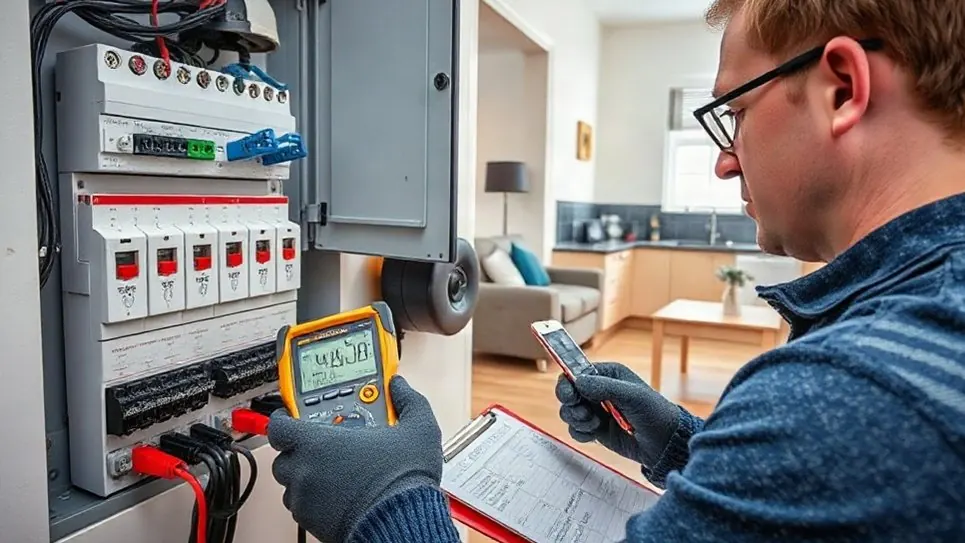
During a social housing EICR in Medway, we inspect the consumer unit for its condition, correct labelling, secure enclosures and suitable protective devices. We check that circuit schedules identify each circuit accurately, blanking plates are fitted, covers are intact and no signs of overheating, damage or unsafe alterations are present.
We assess whether circuit breakers and fuses are correctly rated for the wiring and intended use, and whether RCD protection is provided where required. Our RCD testing confirms operating times and verifies that devices disconnect within prescribed limits. We also consider whether surge protection is required following the risk assessment, particularly where sensitive equipment or building systems could be affected.
Any observed defect is recorded with the appropriate EICR classification, so you can prioritise remedial work and maintain a safe installation.
Earthing and bonding
Beyond the consumer unit, we check that the earthing arrangement and main protective bonding are present, correctly sized, securely connected and suitable for the installation. We verify the means of earthing, including supply-provided terminals or earthing rods where applicable, and assess whether it provides a reliable fault-current path.
We inspect bonding connections to incoming metal water and gas services, where present, confirming accessibility, continuity, conductor size and secure terminations. This helps maintain equipotential bonding, reducing dangerous voltage differences between exposed and extraneous conductive parts during a fault.
We also consider the installation’s supply characteristics and any alterations that could affect protective measures. Missing, damaged or inadequate earthing and bonding can lead to an unsatisfactory EICR outcome, requiring remedial work before the installation can be considered safe for continued use.
Cable condition and insulation resistance
Although visual checks can reveal obvious damage, we also assess cable condition and test insulation resistance to identify deterioration that isn’t visible. During insulation testing, we isolate circuits safely and apply the required test voltage in line with BS 7671 procedures. Results help us identify leakage paths caused by damaged insulation, moisture ingress, heat exposure, poor alterations or cable ageing.
This is particularly important in Medway’s older social housing, where Victorian properties may retain rubber or VIR cabling, and some post-war homes can contain aluminium wiring. We compare readings against regulatory requirements and investigate unsatisfactory results before recording observations on the EICR. Where testing cannot be completed without risk to equipment, we document the limitation clearly and advise on appropriate further investigation. Our aim is to establish whether concealed wiring remains safe for continued service.
Sockets, switches and accessories
We inspect sockets, switches, ceiling accessories and connection points for damage, overheating, insecure fixings, unsuitable locations and signs of poor previous work. We confirm accessories are suitably rated, correctly mounted and protected against foreseeable contact with live parts. Where covers, faceplates or ceiling roses are walderslade, cracked or incomplete, we record the condition and assess whether remedial work is required.
We also check that socket positions remain practical and accessible for occupants, without creating avoidable strain on leads or equipment. This supports socket longevity and reduces the likelihood of unsuitable extensions being relied upon. Switch ergonomics matter too: switches should be reasonably positioned, operable and appropriate for the room’s use, including communal areas. We verify that accessories are compatible with the circuit arrangement and that any observations are coded in accordance with EICR requirements.
Signs of overheating, damage or DIY work
During a social housing EICR, we check for heat damage, discolouration, burning smells, cracked accessories, exposed conductors and damaged cable insulation that could indicate deterioration or excessive load. We inspect consumer units, sockets, switches, junctions and accessible wiring for charred fittings, walderslade terminations and signs of arcing.
We also identify unauthorised DIY alterations, including poorly joined cables, missing enclosures, incorrect protective devices and additions without suitable earthing or RCD protection. Overloaded circuits can cause persistent overheating, particularly where multiple high-load appliances share one circuit. Where defects are found, we record their classification in accordance with BS 7671 and explain whether urgent remedial work is required. You’ll receive clear findings so the responsible housing provider can prioritise repairs, protect tenants and maintain a safe electrical installation.
What the codes mean
We record C1 as immediate danger, C2 as potentially dangerous, C3 as an improvement recommendation, and FI where further investigation is required. | Code | Meaning and action | |---|---| | C1 | Immediate danger; we’ll advise urgent remedial action. | | C2 | Potentially dangerous; remedial work is required. | | C3 / FI | Improvement recommended / further investigation needed. |
We’ll explain each observation clearly so you can prioritise resident safety and achieve a satisfactory EICR where required.
C1, C2, C3 and FI explained
Every observation on a social housing EICR is assigned a code that shows its safety significance: C1 means danger is present and urgent action is needed; C2 identifies a potentially dangerous condition requiring improvement; C3 records an issue that doesn't meet current standards but isn't, by itself, unsafe; and FI means further investigation is required before a conclusion can be reached.
We’ll explain each observation clearly, identify its location and record supporting details. C1 and C2 observations make the report unsatisfactory until appropriately remedied. Where safe and authorised, we may isolate an affected circuit or item to reduce immediate risk. C3 observations don’t require remedial work for a satisfactory outcome, but can guide planned maintenance. FI isn’t a code to disregard: its resolution depends on inspection depth, testing access and further checks. Accurate circuit labelling supports safe isolation and efficient follow-up work.
How long it takes and what we need from you
Although most social housing EICRs in Medway can be completed within a few hours, the exact duration depends on the property’s size, number of circuits and accessibility of the consumer unit, sockets, lighting points and any outbuildings.
To complete the inspection safely and in line with BS 7671, we need reliable tenant access and clear access scheduling arranged in advance. Please make certain the consumer unit is unobstructed, rooms are accessible, and any locked cupboards, loft spaces or external stores can be opened. We’ll need to isolate circuits briefly while carrying out testing, so tenants should be aware that power may be interrupted. Let us know about vulnerable occupants, medical equipment, alarms or access restrictions beforehand. Please also confirm parking logistics, especially on permit-controlled estates, and make certain our electrician can present photo ID on arrival.
What happens if it fails
If an EICR fails, we’ll record defects and issue a fixed quotation for remedial work — typically completed within 14 days at an average cost of £250–£750 per job depending on severity.
If an EICR identifies defects, we’ll record them using the appropriate observation codes and explain which remedial work is needed before the installation can be considered satisfactory. C1 observations indicate immediate danger and require urgent action; C2 issues are potentially dangerous and must be corrected promptly. FI observations need further investigation before safety can be confirmed.
We’ll provide a clear report and a fixed written quotation for the required work. Once repairs are complete, we’ll test the affected circuits and issue confirmation where appropriate. The re‑inspection process verifies that remedial work has resolved the recorded observations.
For social housing providers, arranging repairs and retaining certification are core compliance duties. Tenant responsibilities include providing access at agreed times, reporting damage or electrical concerns, and not attempting unauthorised electrical alterations. If danger is present, we may isolate the affected circuit or equipment to protect occupants.
Recent EICRs near Strood
Because of this, we assess each installation in Strood and its immediate neighbourhoods rather than assume its condition. This approach helps Medway Borough housing teams and local registered providers prioritise remedial work and retain compliant records for properties in Strood and surrounding wards.
The property mix in Medway — dense Victorian terraces in Strood, Chatham and Gillingham, dockyard-era housing, large post-war estates and new-build on the riverside and at Rochester Riverside — means no two jobs are alike. Our electricians spend much of their time on dense rental and HMO stock across five towns, landlord EICRs and fire alarms, riverside new-build snagging and EV chargers, and we plan each visit around the age of the wiring rather than a one-size-fits-all checklist.